Showing posts with label Art of Writing. Show all posts

Wednesday, December 4, 2013

Letting Characters Choose Their Destiny


Kurt Vonnegut famously gave the piece of writing advice that, "Every character should want something, even if it is only a glass of water." By adhering to this maxim my writing has yielded some interesting and surprising results.

Every minor character passing through the panoply of your story's background will have dreams and desires. Some of these desires may be just as simple as wishing for a drink of cool water and others will be much more complicated. Most of these characters are destined to be just bit players in your drama, but one of the most fun and interesting things about being an author is watching these bit players as they begin to assert themselves and follow their own agenda and desires. It's your job as an author to allow them to assert their independence and follow their own path.


Their own path may lead them right out of the story you are telling or, to your surprise, it may lead right into the story you are telling. What do you do with these hangers-on who are muddying up your story? I say that you let them right in and see where their desires and dreams take them. It may surprise you.


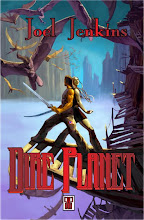
In my own writing, the former cannibal Naegrik inserted himself into the story line of Exiles of the Dire Planet. He started out as a minor character, a Galbran who was hanging in a pesthule larder that Garvey and Ntashia Dire were attempting to escape. He begged for help and though Garvey had just slain hundreds of Galbran in a terrifically bloody battle, he showed mercy upon the unfortunate fellow and that was the moment that Garvey gained one of his best and most loyal friends, who would be with him through the events of Into the Dire Planet, Strange Gods of the Dire Planet, and Lost Tribes of the Dire Planet. I didn't know it at the time.


In my own ignorance of Naegrik's true intentions I thought he might run away at first opportunity, perhaps never to be seen again or perhaps to bring down an enemy Galbran patrol upon Garvey's head at the most inopportune moment. Instead, I let Naegrik dictate it his own actions and it turned out that he had been greatly impressed by Garvey Dire's act of mercy--something he had never seen nor imagined among the Galbran people.  It took some time to win over Garvey's wife, who was highly suspicious of Naegrik's motives, and Naegrik has had a great struggle to convince the people of the Muvari Tribe to accept him. Readers have been more quick to accept Naegrik, and a number of them have let me know that Naegrik is one of their favorite characters--not bad for an incidental encounter and a character that thrust himself into the narrative.


Another Dire Planet character that thrust herself into the narrative--to my great surprise and chagrin--is the flame-haired exile Tredia. She was exiled from her own people for crimes against them and took part in the horrific raid upon the Muvari city of Ledgrim. I thought she was completely self-serving with no thought for anyone but herself, and she was ... but being the lone survivor of that raid had given her time to reflect upon the pitiful state of her existence and her evil actions and she attempted to broker a deal with Garvey Dire--not an entirely unselfish action, but it put her on a path to redemption, which seemed to cemented when she helped the Muvari fend off a pesthule invasion in the teeth of a storm.  I'm not entirely sure where Tredia's path is taking her in future Dire Planet novels ... I'll let her dictate that.


Non-writers (and even some writers) may read the preceding paragraphs and think I've got a mental screw or two loose, to think that some figment of my imagination should be able to dictate its own fate. They may be right; it takes a special kind of crazy to sit down day after day and gather those figments of imagination together into some sort of coherent story.  Yet, writers who adhere too closely to their outlines and who close out the possibilities of incidental characters taking an important role in the narrative are denying themselves some fascinating arcs of character development.  

Wednesday, November 20, 2013

The Art of Action Fiction: Action


One thing I quite enjoy reading is a great action sequence. However, action sequences seem easier to write than they really are. There are a number of ways to kill an action sequence, and here are a few of the possibilities:

1) The protagonist is invincible: Maybe your character is the baddest, toughest son of a gun to ever walk the earth. If the reader doesn't think that perhaps the protagonist is actually in some danger, there becomes no point to the action sequence.  Be sure to inject drama by emphasizing the danger and the difficulty. If the character must do a back flip of a high building onto the arm of a crane in order to avoid a hail of bullets, don't just state that she accomplishes this task.  State the danger of the maneuver due to the high winds and the slick surface of the crane and how if she misses she will end up splattered on the pavement.  Then have her barely succeed at her risky maneuver.  This is a constant problem that writers of Superman tv shows, comics and movies have to deal with.  Bullets bounce of his chest, for crying out loud, how is the reader supposed to be worried about Superman's welfare? So the writers give him an Achilles heel (kryptonite) or they have him face foes with powers equal to his own, or they put other weaker individuals (Lois Lane and Jimmy Olsen) in harm's way so the reader will wonder if Superman  can save them in time.

Which brings us to 2)No One Ever Dies: I once had a woman tell me that much fiction bored her because she already knew the final outcome would result in the hero riding off into the sunset. When I write I don't ever rule out killing the main character if that's where the story leads me. Authors more successful than I have pointed out that this is a huge mistake, since you are also killing off your chance at a franchise or series. There is some truth to this, and I may have figuratively shot myself in the foot more than once. However, killing a character doesn't entirely destroy the option of writing future stories in a series. It is possible to continue by making periphery characters the focus or by writing stories that occur prior to the death of that character.

2) Trust me this what happens: This is a particular weakness of TV shows. I recall watching one spy series, which I enjoyed, where the central character pulls out a large gun (which the audience has never seen before and has no knowledge of) and shoots an oncoming car through the radiator.  At this point the engine explodes in flame and the car screeches to a halt. I was left scratching my head. Why would shooting a car through the radiator cause it to explode into flame? Even if she were shooting an incendiary round this wouldn't happen. Perhaps she had been given some experimental super explosive bullets by the spy agency she worked for, but if that was the case it was never mentioned. Maybe, I'm the exception, but I like to know the how and why of weapons. I find it interesting that some medieval warriors left the edges of their shields without any metal, because the wood might catch a descending weapon and keep it stuck, giving them the opportunity to slay their opponent. I like to know that polearms (an axe or pick with a long handle) were used because the leverage gave them a chance of penetrating plate armor. I'm interested to know how a stun gun creates a build up of lactic acid in the muscle that makes the target incapable of moving. I like to know that the AK-47 is less accurate than the M-16 but it has a more powerful round. Details like this intrigue me, and I imagine that they might intrigue the reader as well.  Most of this sort of information can be boiled down to a sentence or two, so that it doesn't slow down the action, but rather it informs the action and helps the reader understand why the combat is unfolding in the manner it is.

3) Lack of Spacial Recognition: It may be beneficial for some authors to have fired a gun, been in a fistfight or two, wrestled, or simulated sword combat with padded weapons. This helps the author to understand a logical progression of a skirmish. A character shouldn't be backflipping away from a punch and then delivering an uppercut, because if they've backflipped away they are no longer in a position to execute that uppercut. Nor should they easily be punching their sword-carrying enemy, because reach is a huge factor, and anyone attempting to punch a man with a sword will likely get their arm chopped off or their head split open.

4)Lack of Vivid Verbs: A combat scene should be dynamic and awe-inspiring. Why settle for a mere hit when the character can crush, pummel, slam, hammer, and pound? Bullets can slice, tear, rip, pierce, lance, glance and ricochet, and your verbiage can cause the reader to tremble, quake, and quiver!

Wednesday, October 30, 2013

Art of Writing Action Fiction: Writing Habits


One professor of literature, and author of two scholarly treatises on a certain Pulitzer prize-winning American author, once asked me how it was that I managed to finish finish so many novels while holding down a full time job and being a father of a large family.  I told her that in order to compile words on paper, I get up around 5 AM to write.

She rolled her eyes in disbelief, thinking that the idea of such early morning writing was so ludicrous that it must be a joke.  I assured her that it was no joke. When a person is afflicted with the need to tell a story they will sacrifice an extra hour or two of sleep in order to accomplish the end result of a short story or a novel.

My daily goal is one thousand words, five days a week.  Sometimes I manage a little more, sometimes I manage a little less--and some weeks I manage to do six days a week of writing.  At this rate I can write a couple of novels and a couple of short stories a year. Eventually, this adds up.  For me, it has added up to sixteen published novels (by this time The Gantlet Brothers: Sold Out is on the virtual stands), quite a number of published short stories, and another half million words which can be compiled into collections like Weird Worlds of Joel Jenkins or other short story collections like next year's impending Lone Crow Collected, which is over one hundred thousand words of stories about said infamous Native American gunfighter.

The point here is that writing a novel isn't a sprint where one must chain themselves to their typewriter or word processor for three or four weeks until their masterpiece is brought to fruition. Like most endeavors, it is accomplished through steady and consistent effort.  Anyone who wants to write a novel can, by sitting down and writing just one page a day, have a complete novel by the time a year is finished.

I've tried to quit writing many times and there have been short periods of time that I have actually been successful at quitting, but eventually I relapse--because storytelling is an addiction as visceral and real as a drug or alcohol addiction. The only difference is that at the end of the day I've got a novel to show for it instead of a hangover and sclerosis of the liver.

A serious writer will carve out a little bit of time out of their day to put a few words to paper. It's not about finding the time of day that I am most creative and pushing everything else aside so that I can write during that period where I am at my creative peak. For most of us that's impractical. For me, morning is the only time where I can fit in writing around my other responsibilities like family and putting food on the table. So, by sheer necessity, morning becomes my most creative time of day.

I don't wait for my muse to arrive. I order her to be there when I start typing. Sometimes she's a little late, but eventually she gets there.

Monday, May 13, 2013

Cliche vs. Archetype


The rookie cop, the experienced and jaded cop, the crooked cop, the gung-ho cop, the idealistic cop, the buddy cops, the stupid cop, the brilliant detective, the angry sergeant, the cop striving for redemption. What are these? Certain professors of literature, and many a movie or book reviewer would say they are clichés or stereotypes. And we all know that cliches and stereotypes are bad, so as authors we should avoid them like the plague (hey, that turn of phrase qualifies as a cliche), right?

Not so quick, I say. If all these variations on the cop character are cliches—and they have been used many times and many ways—what does an author have left work with? Maybe an author should abandon the idea of writing a cop story at all, maybe tell a story about a struggling farmer. Wait, that's a cliché, too. How about a wealthy farmer, perhaps a plantation owner? Hmm, that's been done, as well.

What's an author to do if he wants to avoid the cries of cliché and stereotype that critics and literature professors will shout out to the world as soon as they flip through your book and find a character that's fits a prototype long since established by other authors who came before you? Probably, the only thing an author can do to avoid these criticisms is to not write anything at all. Because, as I've demonstrated above, there are very few character types that haven't been explored, to some extent, already.

Anytime that a critic or a professor of literature wants to justify their paycheck and prove their intellectual superiority, they can fall back on the criticism of cliché. It's a lazy criticism which will apply to almost any work of fiction, so whenever I see a critic use the term 'cliché' I take their opinion with an extra grain or two salt—because it's too easy of a critique to make, and because a cliché' does not necessarily bad fiction make. Criticizing other people's creative efforts is a situation where the critic often has no skin in the game. In other words, if they're not creating and putting their own work in front of other people, they don't run the risk of subjecting their own creative efforts to the same criticisms and judgments they so liberally dispense. It's easy to sit on the sidelines and yell at the players, but things get more personal when you're in the thick of the game. Only a handful of critics are brave enough to join the game.

Another, less derogatory term, for the mold of a tried and true character is an archetype, and this is the designation that I prefer. A good writer won't shy away from drawing on these archetypes for the characters in their stories. They provide a quickly identifiable character for the reader, which won't slow the pace of the story. Then, gradually, the author may clothe that archetype with flesh and blood, wonts and desires, and the true character will reveal itself. Often the true character will be in-line with the standard archetype, but other times you will find the character revealing secrets about themselves, which may send your story reeling in startling directions. Instead of being afraid of these sudden turns, embrace them, hold on tight and see where the ride takes you.

Villains will suddenly become sympathetic as they reveal that they want to change their stripes. You'll see noble heroes become selfish and fall, you'll see tragedy turn to triumph, and triumph turn to tragedy, and you will be able to tell wonderful stories. And all these stories will contain clichés, because you aren't the first or even the ten thousandth writer to put pen to paper. Clichés are unavoidable, but you can spin these archetypes into golden tales that will thrill, entertain and amaze—even if your local literature professor turns her nose up at your plebeian efforts.


Thursday, April 25, 2013

Purple Prose: A Manifesto


In writerly circles it has become popular to denigrate purple prose and throw the phrase around like an epithet, putting it in the same category as the adverb, and terming it a bane, a blight, and a pox upon all literary endeavors. Not so, say I!

Purple prose is ornate, descriptive, poetic or sensually evocative writing which is thought to break the flow of the story or to draw excessive attention to itself. I contend that, in an effort to distance themselves from the criticism of purple prose, many authors have devolved to the other extreme and write flat, dull and lifeless prose—words that live in a colorless void which lacks any sensuality (and I speak in terms of touch, sight, sound, scent, and taste) or context. This extreme effort to eschew the purple has caused bland, deaf, dumb, and blind writing to become the new norm.

It will come as no surprise to anyone that has read my work, that I have been accused of purple prose. One critic told me that my “dense, descriptive prose gets in the way of the action.” I beg to differ, but ultimately I leave it to the reader to decide if my balancing act between action and description has been successful. Some think so, others do not—and it comes as no surprise to me that the modern reader might find my writing style odd and alien, just as though a child raised on saltless and spiceless foods might find a sudden infusion of flavors strange and unpalatable.

I revel in the muscular verb, the evocative adjective, the sights and sounds transcribed by a far-reaching vocabulary that breathes life into mere markings on a page. Give me the colorful, the lurid, and the vivid and I'll leave the limp, lifeless, and unpoetic to other writers.

Saturday, April 6, 2013

Writing Unrepentant Characters


From the Iliad to the western dime novels, there is a long history of anti-heroes or protagonists that behave with only their self interest in mind and lack virtue, morality, or other heroic values. To the writer, telling a story about such characters provides particular challenges. If a character has no redeeming qualities the reader may not care at all what happens to the protagonist and quit reading. I've discarded many books and short stories, because I didn't care about the protagonist enough to continue.

So what works? What can bring a reader to the table when your main character is a thoroughly unrepentant character of the lowest morals?

  1. Cheat Around the Edges: Though your character lacks many moral principles, he does have at least one good quality or admirable goal. An example of this sort of character is James Bond, who has little in the way of morals or principles (or is willing to compromise them to accomplish his goals), yet he doesn't hesitate to lay his life on the line to protect England from villainous organizations of all stripes and hues. This helps us buy into Bond and care what happens to him, even as he uses and discards strings of women with little regard to what happens to them after he gets the information that he wants. Also, Fleming does a good job of showing Bond's inner turmoil, which the movies rarely reflect, and also of showing the physical and mental toll that his job takes.
  2. Evil vs. Less Evil: The protagonist, though not motivated by the welfare of others, is acting against a greater evil than he, so in effect he becomes the 'good guy' of the piece by contrast. An example of this is Moorcock's Elric of Melnibone.
  3. Selective Story Telling: Your character is a ruthless mercenary who has slaughtered many innocents, but you choose only to tell the stories where he has been wronged by someone else and is seeking redress, or where for some reason he decides that it is in his interest to help another. Conan is a good example of this sort of character. On close examination of his character he has no moral qualms about killing and plundering, but those incidents are glossed over somewhat and the Robert E Howard stories tend to incorporate the first two elements of Cheating Around the Edges and Evil vs. Less Evil. This way, we can relate to Conan, even though the reality is that he might knife us in a dark alley if he thought we might have a few coins in our pocket.


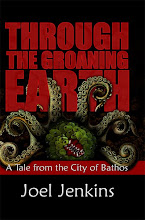
  4. Machinations and Train Wrecks: In part five of Through the Groaning Earth (also available for $2.99 Kindle version), The Jewels of Sagra Yoth, I tell the story of Willen, who has no redeeming qualities whatsoever except for unrestrained ambition. He's a two-bit loser thief and murderer out to make a name for himself. To my surprise, I've had comments from readers that this is one of their favorite sections from the book. Why does this section work, when there is utterly no reason to like Willen or care what happens to him? Here's my theory:
a) The character has a clearly defined goal
b) The character struggles mightily to gain that goal
c)The character uses every bit of his limited brain power to orchestrate his theft, and so we are interested in the machinations and his underhanded efforts.
d)The reader wants to watch the train wreck.

I think this last bit cannot be underestimated. Not only do readers deserve to see the character reap the whirlwind of his poor choices, but the writer has a duty to show that bad decisions have bad consequences. Willen struggles mightily to steal the Jewels of Sagra Yoth and then, in the end, all his evil actions come back to haunt him, and he realizes that maybe he's not quite as smart as he thought.

For another example of thoroughly unrepentant and irredeemable characters look to Derrick Ferguson's Diamondback stories. These stories don't so much use the devices of Cheating around the Edges or Evil vs. Less Evil, or even Selective Story Telling, but rely on the Machinations and Train Wreck principles. The reader is enthralled by all the machinations, double dealings, and backstabbings, and wants to see the ensuing trainwreck. Honestly, I didn't care so much if the deadly killer Diamondback lived or died, but I did want to see how everything played out, and that kept me reading until the very last word.

Friday, April 6, 2012

Low Noon and Choosing Anthologies

I have a completely unprofessional and unmercenary way of choosing which anthologies I am going to submit stories to.  What I do is, I peruse various guidelines and pick anthologies that have genres I am interested in writing, and especially anthologies for which I can write stories using characters I have already created and have an affinity for. I don't recommend this method for writers whose sole income is derived from writing, but if I can't figure out an angle that interests me I'm not going to bother writing a story I don't like.

Now, it still happens that not all editors are keen on my stories, but if they reject my work then, at least, I have one more story towards completing a collection of tales featuring the same character.  So my time and effort were not wasted even if I don't make the sale.

Speaking of anthologies which I've written a story for, check out Low Noon, an anthology of Weird West tales which includes Five Disciples, a Lone Crow story.  Lone Crow is an infamous Native American gunslinger who roamed the West (and a number of other places) and here we find him on the Barbary Coast hunting Shotgun Ferguson, a wanted killer.  Throw in a witch and five disciples of the Immortals and you get havoc and destruction on Telegraph Hill.  Low Noon is available on Amazon in both hard copy and Kindle formats.  If you are a Prime Member of Amazon you can actually borrow a digital reading copy of Low Noon at no cost.

Saturday, February 25, 2012

Shooting Myself in the Foot in the Weird West or Following My Muse

The .45 Peacemaker on the right is the Eagle-butted Peacemaker that Lone Crow carries.

Robert E Howard related how he felt that at times his own character, Conan, would stand at his shoulder and relate his adventures while Howard sat the typewriter transcribing them. These stories seemed to come in no particular order, and after a time Conan left—perhaps to pay a visit at some later date.

As a writer I often feel similarly: as though the characters, themselves—not me—have certain stories to relate. When they start relating these stories I don't necessarily have much control over where and how they take place. Or to put it bluntly, I'm a victim of my muse.

How am I a victim of my muse? I'll give you an example. I recently completed a trio of Weird West short stories featuring famed Native American gunfighter, Lone Crow. These were intended for placement within three different upcoming Weird West anthologies. The story ideas were not a problem for me to develop because, it seemed, that Lone Crow was at my shoulder rehearsing the tales.

However, after I completed the three stories I realized that none of them actually took place west of the Mississippi. Sure, they were all firmly set in the era of the old west, but one story took place in Brazil, another took place in Arkham Massachussetts, and the third transpired in New York City.

One editor quickly confirmed my suspicions that I had shot myself in the foot. He liked the story, but it didn't take place in the West and so it wasn't a Western, and not a good fit for the anthology he was editing.

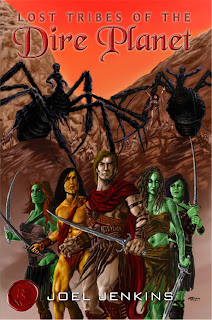
One of the reasons that I have eleven published novels (number twelve, Lost Tribes of the Dire Planet, on the way next month) is that when it comes to writing I am unreasoningly and blindly persistent in the face of all common sense and logic. Instead of writing, surely, it would be more profitable for me to get some exercise, or maybe even get more sleep or watch TV? Okay, maybe not the last one. But still I persist in writing.

Lone Crow still seemed to be hanging around the home library where I do my writing, perusing a copy of Herbert Asbury's Barbary Coast, so I asked him, “Do you happen to have any adventures that took place somewhere in the West?”

“There was the time that I tried to bring in Shotgun Ferguson for murder,” said Crow.

And I was off and running, typing words as fast as my fingers could fly across the keyboard. I managed to slide the story in before the deadline, and this time Lone Crow's tale was more to the editor's liking.

For me, it seems the demands of an editor and muse most often don't mesh, but occasionally—with some prodding—I can get them to cooperate.

Saturday, October 17, 2009

Kings of the Night

G.W. Thomas's online fantasy magazine, Kings of the Night has some very nifty fantasy tales and also features some great artwork by M.D. Jackson (see the included painting). He even has a section on Sword and Planet stories and makes mention of the Dire Planet series (which Amazon is carrying at the new low price of $11.95 each) in a most complimentary way! Check out the Sword and Planet section here.

As a side note, I'm currently entrenched in writing the fourth Dire Planet novel, Lost Tribes of the Dire Planet, which I'm about 25,000 words into. As usual, the characters are dictating the story to me--instead of the other way around. The former galbran, Naegrik, is making himself a prominent part of the story. Also, an exile warrior who took part of the invasion of Ledgrim --who I thought was going to be a minor nemesis in this novel--has let me know that she has contradictory plans of her own.

Of course, these are just a couple elements of the novel. Kurt Vonnegut has said, about writing, that every character in a scene should want something-- even if it's just a glass of water. I find that when I listen to my characters wants and desires that the plot thickens in ways that I never imagined, and minor characters surprise me and become major players.

Saturday, May 2, 2009

Tying up the Loose Ends

I do like to leave a few loose story threads hanging in a novel length work, because they give me something to pick up and run with at a later time. Also, if one ties up things too firmly, it all seems a little too neat. A few ragged edges lend some reality.

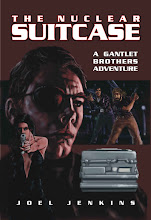
However, In finishing up this round of editing on the Nuclear Suitcase I find that the ending is a bit abrupt. Sure, I wrap up all the major plotlines in The Nuclear Suitcase, but there are a few niggling details and threads that are lingering in my mind. Some of these will tie up nicely in an epilogue, but inevitably some of these will just create a few more loose threads--fodder for future Gantlet tales, perhaps.

Guess, I'd better get to work on that epilogue.

Thursday, February 5, 2009

Constructing the Short Story

I admit that I'm not much of a short, short story writer. I have little use for flash fiction which offers all of two or three hundred words to develop character, plot, problem, and solution. I have nearly as much difficulty trying to tell a tale in under 8,000 words.

Case in point, Against the Gathering Darkness--a weird western tale I wrote recently with an invitation to submit it for a weird west anthology for Pulpwork Press. The target word count was between 7,000 and 8,000 words.

I finished the story in something over 12,000 words. The editor of the anthology kicked it back and said to shorten it or he couldn't use it.

Unlike Stephen King I'm not an advocate of cutting out 1/3 of my manuscript during the editing process. I write lean stories with very little in the way of the extraneous. If I cut a third of the story it wouldn't hang together very well.

My solution? Submit Against the Gathering Darkness elsewhere and write another much shorter story featuring Lone Crow (and without Wyatt Earp this time, Wyatt's got lots of baggage and requires more words). With only 6,000 to 7,000 words to work with I've decided to cut my story structure to the bare bones:

1) Introduce characters and problem
2) Resolve Problem

In the process of a longer story there are usually a number of characters introduced throughout, and quite a few steps taken to resolve the problem of the story. Not so with the short story. In Wyrm over Diablo it's taken me about 3,000 words to introduce the characters and the problem. Now I've embarked on the second half of the story structure--resolving the problem.

I think I can do it in under 6,000 more words...er I mean in under 5,000 more words.