Thursday, February 6, 2014
Writing a Biography
Here's a review of my novel One Foot in My Grave which is appended with an interview which examines the idea of approaching a biography from a first-person view point.
Monday, February 3, 2014
Saturday, January 25, 2014
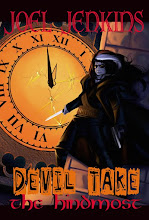
Author Josh Reynolds (author of the excellent The White Chapel Demon which features his own occult investigators Charles St. Cyprian & Ebe Gallowglass) hosts an Occult Investigator blog which is now featuring a bio on Damon St. Cloud from my Devil Take the Hindmost novel and Blood Vault chapbook. This is the second time Josh has featured an occult investigator of my creation on his website--the first being Lone Crow.
Speaking of Lone Crow, I've got a hefty collection of Crow stories, called The Coming of Crow, hitting Amazon this summer.
Thursday, January 9, 2014
The Eye of Ulutoth
Strange Trails was recently reviewed at the Pulp Fiction Reviews website by the inestimable Ron Fortier. This collection of weird western tales includes a story entitled The Eye of Ulutoth, which features the Indian gunfighter and occult investigator Lone Crow and Six-Gun Susannah Johnson (who is maybe the fastest draw in the west, but perhaps not the most accurate shooter) as they attempt to dispose of an ancient evil artifact on a steamer somewhere off the coast of Costa Rica. This same story was recently nominated for a Pulp Factory Best Short Story award.
As a rule, there's stiff competition for these awards, so a nomination may be as far The Eye of Ulutoth goes. However, please do give Strange Trails a read and I suspect you'll enjoy the stories within. At the moment, Strange Trails is available in Kindle format for a mere 99 cents and the print copy is running under seven bucks.
Tuesday, December 31, 2013
What I've Been Up To In 2013
At the end of the last couple of years I've made a habit of summing up my annum of literary endeavors. In 2013 a handful of my stories and novels managed to make it into print. Here's the round-up:
When September's cheerleader fiancee dumps him for a college man, September picks fast cars, motorcycles, and hard alcohol to do the trick, then witnesses his life unravel into a series of death defying encounters--all the while battling his own inner demons.
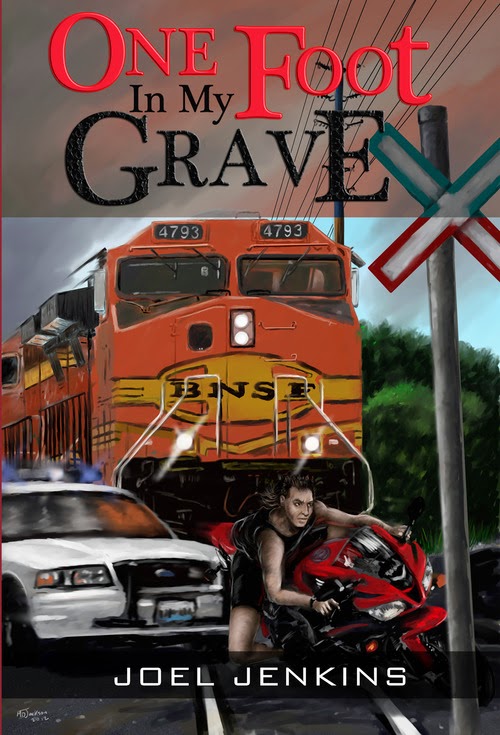
One Foot in My Grave
September Peterson has received death sentences many times from well-meaning doctors speaking in hushed tones. Living with cystic fibrosis means that he'll die from cystic fibrosis--a long and excruciating death--unless, by tempting fate, he can find a quicker, faster way to go.
When September's cheerleader fiancee dumps him for a college man, September picks fast cars, motorcycles, and hard alcohol to do the trick, then witnesses his life unravel into a series of death defying encounters--all the while battling his own inner demons.
OK Corral Article
This extremely short article appeared in Science Fiction Trails #10.
Weird Worlds of Joel Jenkins
From an ancient temple in the icy Martian mountains to a forbidden road haunted by the ghost of an Indian brave, this collection of tales will take you on a thrilling journey. Meet vampire hunters, a rock musician who takes on the heavyweight champion of the world, the reluctant warrior of the mystical land of Saffronyia, giant Nazi robots, and the Mormon gunfighter Porter Rockwell ... as well as a few hungry apes and one very lovely assassin.
Strange Trails
This contains a Lone Crow story titled The Steam Devil (written by me), not to mention a Mr. Brass story by Josh Reynolds and some other awesome stuff.
Six-Guns & Space Ships
This contains a nifty tale, Shootout at Hangar 2112, about Captain Barclay and his motley crew of intrepid spaceway salvagers, who find themselves on a hit list, and besieged by deadly bounty hunters from the dark corners of the galaxy.
Jim Anthony: Super Detective #4
The classic pulp character Jim Anthony returns in a collection of stories which includes The Scream Hammer, in which Anthony uncovers a Nazi plot, a secret super weapon, and scrambles to save the love of his life.
The Gantlet Brothers: Sold Out

When one of the infamous Gantlet Brothers is slain in an assassination that was intended to kill them all, the remaining brothers go on the warpath. From the sunny shores of Puerto Rico to the dank back alleys of London, and behind the Iron Curtain of communist Czechoslovakia, the Gantlets hunt the cadre of assassins responsible for their brother’s death, uncovering conspiracies and plots as they work their way back to the criminal warlord that is behind it all.
The PulpWork Christmas Special 2013
I contributed the fourth and final story, The Shadow Killers, to this collection. in which cold-hearted assassin Monica Killingsworth finds herself the reluctant, but extremely well paid, escort of a small child and becomes the target of merciless killers ... some of which she has worked with before.
Robots Unleashed
And coming in just under the wire for 2013 is Robots Unleashed! which includes a tale about expert escape artist, The Eel, and master of disguise, The Adder, as well as giant Nazi robots.
That makes 2 novels, 1 collection, 1 article, and 5 novellas and short stories to see print this year. Not too bad for a worthless layabout like myself. Next year I've got just one book scheduled, the highly anticipated (and by that I mean at least four people have mentioned they are looking forward to it) Lone Crow collection of weird west stories, The Coming of Crow. What else 2014 will bring only heaven knows.
Monday, December 30, 2013
The Dark Side to Promotions
The problem with running a free Kindle promotion on a book is that a lot of readers who wouldn't normally read the book because it's not their cup of tea, pick it up for free and then trash it in an Amazon review because it's not their cup of tea. This can happen across genres--for an example a reader who hates romance novels, tries one out at no cost, and then savages it because it has too much romance and not enough action. It can also happen with subgenres.
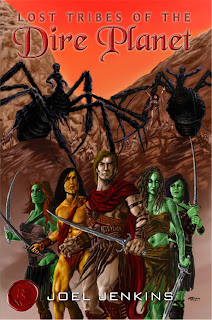
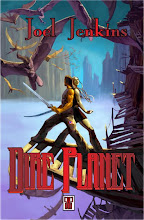
My Dire Planet series fits into the broad genre of Science Fiction, but the genre contains everything from Space Opera (action-oriented stories against the backdrop of space) to hard science fiction (stories more concerned with exploring a scientific theory or principle). Dire Planet falls into the Space Opera end of the spectrum, and more specifically into the subgenres known as Planetary Romance or Sword & Science Fiction, as I like to call it. After a free promotion one reader ripped it for "taking the science out of science fiction." Clever enough, and perhaps I'll use that in a promotional blitz. However, the books were never intended to be an exploration of science fact or theory.
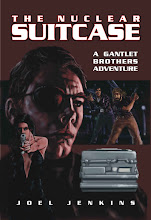
Again, the Thriller genre covers a broad range of subgenres and my Gantlet Brothers series falls into the Action-Adventure end of that or what some term New Pulp, which indicates fast-paced story with plenty of action. One reader who sampled The Nuclear Suitcase (the first book of the series) at no cost slammed it as "awful" and said there was too much action, and the idea of mercenary/rockstars was ludicrous. Maybe, but remember the 90's when rappers were running around shooting each other? Normally, a reader who thought the idea of a book was ludicrous would read another book, but since they're getting a book for free they read something they're predisposed to dislike and gleefully tear it apart. A reader who thinks the idea of gun-toting rock musicians might be cool, instead of hating the concept, will be more likely to post a favorable review.
The occupational hazards of a writer (or any other creative person) putting their work into the public arena are the folks that are predisposed to dislike the sort of art you are creating, and those who just plain get their kicks out of tearing down what others have built, because it's easier than building something themselves. Exposing yourself to the critical darts of the general public may seem like a fair trade to somebody that is pulling in a hundred thousand dollars or more for a novel, but the vast majority of creatively-inclined people are doing it for the love of their art, and making a few pennies an hour for their efforts. For those of us in the latter category, it might seem a safer pursuit to create our works of art and cloister them away on our hard-drives, in our desk drawers, away from the public eye--or perhaps we can avoid the trolls looking for free fodder for their condescendence by pricing our work so that only those inclined to like it will view it? Each author will have to weigh in balance the pros and cons of the added exposure of a book giveaway versus the resultant negativity that is sure to result as well.
At any rate, as I muddle through various promotional efforts the latest book from PulpWork Press, the PulpWork Christmas Special 2013, which contains a Christmas story be me as well as authors Percival Constantine, Josh Reynolds, and Russ Anderson, Jr. seems to have garnered a couple of nice reviews in the Cedar Rapids Examiner and in the Noir Journal. The good reviews help to balance out the bad.
Wednesday, December 25, 2013
PulpWork Christmas Special 2013
Merry Christmas! December 25th through December 29th download a free Kindle copy of The PulpWork Christmas Special 2013 on Amazon.com.
Here's a description of the PulpWork Christmas Special:
Four tales of yuletide murder and mayhem from the mighty pens of Josh Reynolds, Russ Anderson Jr, Percival Constantine, and Joel Jenkins.
The Third Death of Henry Antrim: Royal Occultist Charles St. Cyprian and his companion-in-arms, the lovely, gun-toting, and slightly bloodthirsty Ebe Gallowglass, discover murder most foul, a holy relic in the form of a Colt .45 pistol, and an evil sprung up from the wildlands of the weird west.
The Wild Hunt: When the vulpine changeling Asami encounters a restless spirit wandering the icy slopes of Kurodake, Japanese legend clashes with Norse mythology and she finds herself caught up in the midst of a mythic hunt.
Malcom Destroys Christmas: A seven-year-old boy swears vengeance upon Santa Claus and the malign menace known only as Krampus decides to enlist him in a dastardly plot against Father Christmas.
The Shadow Killers: Cold-hearted assassin Monica Killingsworth finds herself the reluctant, but extremely well paid, escort of a small child and becomes the target of merciless killers, some of which she has worked with before. But Killingsworth knows a thing or three about assassination and bullets, blood, and bombs fly on Christmas day.
Sunday, December 15, 2013
The Book Caves Sells Out
Ric Croxton, Art Sippo and their respective alter egos, the welterweight boxing champion Ricardo Croxton and the concierge for the Black Cemetery hotel Arturo Sippo, recently interviewed an obscure writer named Joel Jenkins on their Book Cave Podcast.
The discussion largely revolved around the third book in the Gantlet Brother series, The Gantlet Brothers: Sold Out, and the bloody demise of one or more of those brothers. Give it a listen!
Wednesday, December 4, 2013
Letting Characters Choose Their Destiny
Kurt Vonnegut famously gave the piece of writing advice that, "Every character should want something, even if it is only a glass of water." By adhering to this maxim my writing has yielded some interesting and surprising results.
Every minor character passing through the panoply of your story's background will have dreams and desires. Some of these desires may be just as simple as wishing for a drink of cool water and others will be much more complicated. Most of these characters are destined to be just bit players in your drama, but one of the most fun and interesting things about being an author is watching these bit players as they begin to assert themselves and follow their own agenda and desires. It's your job as an author to allow them to assert their independence and follow their own path.
Their own path may lead them right out of the story you are telling or, to your surprise, it may lead right into the story you are telling. What do you do with these hangers-on who are muddying up your story? I say that you let them right in and see where their desires and dreams take them. It may surprise you.
In my own writing, the former cannibal Naegrik inserted himself into the story line of Exiles of the Dire Planet. He started out as a minor character, a Galbran who was hanging in a pesthule larder that Garvey and Ntashia Dire were attempting to escape. He begged for help and though Garvey had just slain hundreds of Galbran in a terrifically bloody battle, he showed mercy upon the unfortunate fellow and that was the moment that Garvey gained one of his best and most loyal friends, who would be with him through the events of Into the Dire Planet, Strange Gods of the Dire Planet, and Lost Tribes of the Dire Planet. I didn't know it at the time.
In my own ignorance of Naegrik's true intentions I thought he might run away at first opportunity, perhaps never to be seen again or perhaps to bring down an enemy Galbran patrol upon Garvey's head at the most inopportune moment. Instead, I let Naegrik dictate it his own actions and it turned out that he had been greatly impressed by Garvey Dire's act of mercy--something he had never seen nor imagined among the Galbran people. It took some time to win over Garvey's wife, who was highly suspicious of Naegrik's motives, and Naegrik has had a great struggle to convince the people of the Muvari Tribe to accept him. Readers have been more quick to accept Naegrik, and a number of them have let me know that Naegrik is one of their favorite characters--not bad for an incidental encounter and a character that thrust himself into the narrative.
Another Dire Planet character that thrust herself into the narrative--to my great surprise and chagrin--is the flame-haired exile Tredia. She was exiled from her own people for crimes against them and took part in the horrific raid upon the Muvari city of Ledgrim. I thought she was completely self-serving with no thought for anyone but herself, and she was ... but being the lone survivor of that raid had given her time to reflect upon the pitiful state of her existence and her evil actions and she attempted to broker a deal with Garvey Dire--not an entirely unselfish action, but it put her on a path to redemption, which seemed to cemented when she helped the Muvari fend off a pesthule invasion in the teeth of a storm. I'm not entirely sure where Tredia's path is taking her in future Dire Planet novels ... I'll let her dictate that.
Non-writers (and even some writers) may read the preceding paragraphs and think I've got a mental screw or two loose, to think that some figment of my imagination should be able to dictate its own fate. They may be right; it takes a special kind of crazy to sit down day after day and gather those figments of imagination together into some sort of coherent story. Yet, writers who adhere too closely to their outlines and who close out the possibilities of incidental characters taking an important role in the narrative are denying themselves some fascinating arcs of character development.
Wednesday, November 27, 2013
World Building In Action Fiction
The rule for world building in Action Fiction is simple: Never use a paragraph when a sentence will suffice.
Successfully executing this maxim, however, takes restraint and the development of certain skills. The idea is to avoid infodumps--long passages that explain the world in which the character resides and which slow down the progression of the story line. Many readers find these passages deadly boring and may discard your story in favor of something that requires less attention span--like TV or a video game. Even a couple paragraphs of exposition can be too much.
The trick is divulging bits about your carefully crafted world on a need-to-know basis. If the reader doesn't need to know how the complexities of Muvari tribal politics work in order to understand the story line then I leave it out. Thus far, I've written five Dire Planet books, and in each one the reader learns a little bit more about the politics of the Muvari Tribe. Why didn't I lay out all this in the first book? Because I didn't need to. I laid a few hints, but provided just enough information for the reader to understand the story that I was telling at the time. The rest I saved for future books.
One excellent method for world building is through dialogue. If you listen to conversations around you, you'll likely hear people discussing various aspects of civilization as it applies to their lives; this includes politics and government. The characters in your novels will naturally have similar inclinations, and through their discussion you may be able to bring out certain points that are necessary to the development of your world, and more importantly your plot.
Another method I use is footnotes. I find etymology fascinating and I often footnote certain words or phrases that the ancient warrior tribes of Mars use. These side notes about the development of these expressions or colloquialisms are not necessary to the story. In fact, if I included them in the text of the story they would certainly slow it down. I provide the footnotes in case the reader is interested in further information. If they are, they will refer to and enjoy the footnotes. If the reader finds all of this dreadfully boring and wants to get on with the story all he needs to do is ignore those footnotes and get on with his reading. They haven't missed anything absolutely necessary to the story.
"But, Joel, I have reams of notes describing every aspect of my fictional world. All that detail will be wasted if I don't include it in my novel!"
If those reams of notes have been helpful to you in telling a good story, then they were not wasted. The real danger is in letting all those notes take over the story you are attempting to tell. Besides, if you write a successful fantasy or science fiction series you can always compile and release those notes for hardcore fans--the same type of hardcore fans that enjoyed Tolkien's Silmarillion.
Wednesday, November 20, 2013
The Art of Action Fiction: Action
One thing I quite enjoy reading is a great action sequence. However, action sequences seem easier to write than they really are. There are a number of ways to kill an action sequence, and here are a few of the possibilities:
1) The protagonist is invincible: Maybe your character is the baddest, toughest son of a gun to ever walk the earth. If the reader doesn't think that perhaps the protagonist is actually in some danger, there becomes no point to the action sequence. Be sure to inject drama by emphasizing the danger and the difficulty. If the character must do a back flip of a high building onto the arm of a crane in order to avoid a hail of bullets, don't just state that she accomplishes this task. State the danger of the maneuver due to the high winds and the slick surface of the crane and how if she misses she will end up splattered on the pavement. Then have her barely succeed at her risky maneuver. This is a constant problem that writers of Superman tv shows, comics and movies have to deal with. Bullets bounce of his chest, for crying out loud, how is the reader supposed to be worried about Superman's welfare? So the writers give him an Achilles heel (kryptonite) or they have him face foes with powers equal to his own, or they put other weaker individuals (Lois Lane and Jimmy Olsen) in harm's way so the reader will wonder if Superman can save them in time.
Which brings us to 2)No One Ever Dies: I once had a woman tell me that much fiction bored her because she already knew the final outcome would result in the hero riding off into the sunset. When I write I don't ever rule out killing the main character if that's where the story leads me. Authors more successful than I have pointed out that this is a huge mistake, since you are also killing off your chance at a franchise or series. There is some truth to this, and I may have figuratively shot myself in the foot more than once. However, killing a character doesn't entirely destroy the option of writing future stories in a series. It is possible to continue by making periphery characters the focus or by writing stories that occur prior to the death of that character.
2) Trust me this what happens: This is a particular weakness of TV shows. I recall watching one spy series, which I enjoyed, where the central character pulls out a large gun (which the audience has never seen before and has no knowledge of) and shoots an oncoming car through the radiator. At this point the engine explodes in flame and the car screeches to a halt. I was left scratching my head. Why would shooting a car through the radiator cause it to explode into flame? Even if she were shooting an incendiary round this wouldn't happen. Perhaps she had been given some experimental super explosive bullets by the spy agency she worked for, but if that was the case it was never mentioned. Maybe, I'm the exception, but I like to know the how and why of weapons. I find it interesting that some medieval warriors left the edges of their shields without any metal, because the wood might catch a descending weapon and keep it stuck, giving them the opportunity to slay their opponent. I like to know that polearms (an axe or pick with a long handle) were used because the leverage gave them a chance of penetrating plate armor. I'm interested to know how a stun gun creates a build up of lactic acid in the muscle that makes the target incapable of moving. I like to know that the AK-47 is less accurate than the M-16 but it has a more powerful round. Details like this intrigue me, and I imagine that they might intrigue the reader as well. Most of this sort of information can be boiled down to a sentence or two, so that it doesn't slow down the action, but rather it informs the action and helps the reader understand why the combat is unfolding in the manner it is.
3) Lack of Spacial Recognition: It may be beneficial for some authors to have fired a gun, been in a fistfight or two, wrestled, or simulated sword combat with padded weapons. This helps the author to understand a logical progression of a skirmish. A character shouldn't be backflipping away from a punch and then delivering an uppercut, because if they've backflipped away they are no longer in a position to execute that uppercut. Nor should they easily be punching their sword-carrying enemy, because reach is a huge factor, and anyone attempting to punch a man with a sword will likely get their arm chopped off or their head split open.
4)Lack of Vivid Verbs: A combat scene should be dynamic and awe-inspiring. Why settle for a mere hit when the character can crush, pummel, slam, hammer, and pound? Bullets can slice, tear, rip, pierce, lance, glance and ricochet, and your verbiage can cause the reader to tremble, quake, and quiver!
Wednesday, November 13, 2013
The Art of Action Fiction: Writing Under Hypnosis
Derrick Ferguson (author of the awesome Dillon series) and I have several times had the conversation about how we get into a writer's trance when writing. What is the writer's trance, you might ask? It's that mental head-space where words start to flow for the author and the story seems to start telling itself or (as author Robert E Howard put it) when it seems that the protagonist of your story is standing at your shoulder and telling it to you as you put it to paper. It's that golden time where the author doesn't have to struggle for the words and they seem to drop like manna from heaven to sprinkle the pages of your manuscript.
Derrick's wife, Patricia, as an observer of Derrick falling into the writer's trance became convinced that Derrick was using a form of self-hypnosis to put himself into this golden creative state. At first I wasn't sure what to make of this observation, but as I've considered it I have become convinced that Patricia was not at all mistaken.
When I'm at my most productive I am able to shut out all outside distractions and I mentally become enveloped in the story that I am telling. At this point the words seem to flow out of me and I'm not sitting in front of my word processor, I'm completely absorbed in some fantastic world of my own creation.
Most websites that discuss hypnosis and writing speak of utilizing hypnosis as a tool to help writers overcome their writers block, but I'm more concerned with the direct application of hypnosis to stimulate the creativity of a writer that's already writing. There may be some natural ability instinctive to some writers that allow them to fall into this hypnotic state, but there are a couple of methods and tools that I find helpful for bringing me into The Zone.
1) Ritual: If you repeat certain actions before writing you may find that you are more mentally prepared for reaching The Zone. This may include enjoying a cup of hot chocolate or a good stretch or maybe reviewing a few paragraphs of your story. It also might be helpful to write at a particular time every day, so that you become conditioned to falling into a state of self-hypnosis at that time during the day.
2) Leave it in the Middle of the Action: When I'm finishing up my daily writing I'm always tempted to speed through the action and end it at a point where I'm not sure, yet, where the story is going. If you leave off your writing in the middle of something where you still have ample inspiration, it makes getting into your next day of writing much easier.
3) Music: I've got a wide variety of music available on my computer and I like to shuffle it while I write. I find that this is an immense help for quickly drawing me into the story and getting me into that state of self-hypnosis. However, this can cut both ways. I am a musician and if I play the music too loudly instead of being drawn into the hypnotic state I can be pulled out of it by lyrics or guitar. However, when played at low levels I find it conducive to stimulating the hypnotic trance where I'm completely absorbed in my writing.
This all may sound a bit hocus pocus to those who have never experienced the writer's trance, and a writer should hone his discipline to write under any variety of circumstances. However, utilizing these techniques can greatly increase a writer's productivity.
Wednesday, November 6, 2013
The Art of Action Fiction: The Proof Copy Edit
There's a lot of advice given to authors about the importance of having another set of eyes review your manuscript because the outside editor will view the manuscript without preconceived notions of what the author thinks the reader understands, and because when reviewing a manuscript the author tends to, in his mind, fill in missing articles and information, even though they may not be on the page.
When I received a proof copy of The Gantlet Brothers: Sold Out for review I left it sitting on my desk for a couple of months, instead of rushing to do a final edit. Part of this was procrastination, because I know that editing is a time consuming process that eats away at minutes that could be used to be creating some new story, but the other part of my reasoning is that it's wise for an author to give their manuscripts time to cool off.
Once the author is away from their manuscript for a time, they forget how they intended certain sentences to read, and are able to view the story with fresher eyes. Even though I had edited the manuscript at a prior time, and then it had been edited by a professional editor, I found things that we had both missed.
Here's an impartial list of things I found:
Easy to make errors: at least one your (possessive) which should have been a you're (you are), and it's (it is) that should have been an its (possessive), a few instances where the plurality of the verb didn't manage the plurality of the object.
Continuity errors:
A) When Matthias enters communist Czechoslovakia his 44 magnum Desert Eagle is mentioned, yet he never uses it--instead using his 454 Cassul revolver. Now, Matthias has been known to carry both pistols at the same time, but I found it better to remove the mention of the Desert Eagle and replace it with a mention of the 454.
B) Matthias is betrayed while helping a Czech priest escape from the dreaded Pancrac Prison. He grabs the betrayer and twists his arm up behind his back, and in the uncorrected version there is an audible crack which might indicate his arm is broken, yet later in the manuscript the betrayer is able to drive a motorcycle without any difficulties. I removed the cracking noise and problem solved.
C) Fritz loads the "last" belt of ammunition into his Swiss machine gun twice. I'm not sure how he managed that--probably the same way that, in many movies, cowboys with one six-shooter manage to fire eleven bullets. Anyway, I deleted "last" and the problem is fixed. I try to keep track of how many bullets characters are firing and make sure that their guns actually hold that many rounds.
Repetitive Words: This is one that my pro editor doesn't seem to spot. Sometimes I will use the same word (and I'm not talking about the, a, this, that and there) in adjacent sentences. I like to minimize this practice and use a synonym, or sometimes I discover the word isn't necessary at all in one of the sentences.
Missing quotation marks: It's just one stroke of the typewriter, but a missing quotation mark can be confusing to the reader.
Clarity: Sometimes an article like it, him or her is not precise enough and the reader can be confused about which it, him, or her the writer is referring to. In these instances, it is best to replace that article with a specific.
Extra Prepositions: Take an especially close look at any instance where you might have two prepositions next to each other. Often, one of these prepositions is unnecessary. Sometimes I find these extra prepositions which have crept into the initial draft. They tend to clutter the sentence. If the sentence still makes perfect sense without the extra in, over, by, through, or under I delete it.
So, sum and total, I'm glad I took the time to peruse Sold Out one more time, because I found many errors, and imprecisions that I was able to improve. Is Sold Out perfect now? Unlikely, but a writer has to send his baby out into the world sometime.
Wednesday, October 30, 2013
Art of Writing Action Fiction: Writing Habits
One professor of literature, and author of two scholarly treatises on a certain Pulitzer prize-winning American author, once asked me how it was that I managed to finish finish so many novels while holding down a full time job and being a father of a large family. I told her that in order to compile words on paper, I get up around 5 AM to write.
She rolled her eyes in disbelief, thinking that the idea of such early morning writing was so ludicrous that it must be a joke. I assured her that it was no joke. When a person is afflicted with the need to tell a story they will sacrifice an extra hour or two of sleep in order to accomplish the end result of a short story or a novel.
My daily goal is one thousand words, five days a week. Sometimes I manage a little more, sometimes I manage a little less--and some weeks I manage to do six days a week of writing. At this rate I can write a couple of novels and a couple of short stories a year. Eventually, this adds up. For me, it has added up to sixteen published novels (by this time The Gantlet Brothers: Sold Out is on the virtual stands), quite a number of published short stories, and another half million words which can be compiled into collections like Weird Worlds of Joel Jenkins or other short story collections like next year's impending Lone Crow Collected, which is over one hundred thousand words of stories about said infamous Native American gunfighter.
The point here is that writing a novel isn't a sprint where one must chain themselves to their typewriter or word processor for three or four weeks until their masterpiece is brought to fruition. Like most endeavors, it is accomplished through steady and consistent effort. Anyone who wants to write a novel can, by sitting down and writing just one page a day, have a complete novel by the time a year is finished.
I've tried to quit writing many times and there have been short periods of time that I have actually been successful at quitting, but eventually I relapse--because storytelling is an addiction as visceral and real as a drug or alcohol addiction. The only difference is that at the end of the day I've got a novel to show for it instead of a hangover and sclerosis of the liver.
A serious writer will carve out a little bit of time out of their day to put a few words to paper. It's not about finding the time of day that I am most creative and pushing everything else aside so that I can write during that period where I am at my creative peak. For most of us that's impractical. For me, morning is the only time where I can fit in writing around my other responsibilities like family and putting food on the table. So, by sheer necessity, morning becomes my most creative time of day.
I don't wait for my muse to arrive. I order her to be there when I start typing. Sometimes she's a little late, but eventually she gets there.
Friday, October 25, 2013
Free Nuclear Suitcases
The Gantlet Brothers escaped from Communist Germany over the Berlin wall in the early 1980's and embarked on a career as rock musicians--a career punctuated by gunfire and violence.
At this moment and through the 29th of October The Nuclear Suitcase is available as a free Kindle download at Amazon.com. This is the first in the Gantlet Brother series, followed by The Gantlet Brothers Greatest Hits and The Gantlet Brothers: Sold Out.
Saturday, October 5, 2013
Sold Out for Sale
When one of the infamous Gantlet Brothers is slain in an assassination that was intended to kill them all, the remaining brothers go on the warpath. From the sunny shores of Puerto Rico to the dank back alleys of London, and behind the Iron Curtain of communist Czechoslovakia, the Gantlets hunt the cadre of assassins responsible for their brother’s death, uncovering conspiracies and plots as they work their way back to the criminal warlord that is behind it all.
And this is for sale at Amazon in both dead tree (currently discounted from $13.95 to $12.57) and digital format ($3.95).
Monday, September 30, 2013
The Scream Hammer
A little while ago I wrote a story featuring the classic pulp character Jim Anthony. It's now available in this nifty collection.
He’s half Comanche, half Irish and
ALL AMERICAN!! Jim Anthony the Super Detective returns in his fourth
volume of brand new adventures from Airship 27 Productions.
Managing Editor Ron Fortier expressed
his enthusiasm for this latest release. “Bringing back old classic
pulp heroes is the reason we created Airship 27 Productions in the
first place,” he reiterated. “Thanks to our efforts, new readers
are discovering the real fun of such B characters as we purposely
bring them to the forefront and put the spotlight on them. At
Airship 27 Productions they become A list heroes.”
Traveling the globe, Anthony battles
all manner of twisted villainy in four new tales and his challenges
are herculean. Writers Erwin K. Roberts, Joel Jenkins, Frank Byrns
and Mark Justice have whipped up a quartet of high adventure stories
that are the hallmark of the Super Detective. From Mexico, where he
encounters a Nazi spy ring to the streets of Manhattan where he hunts
down a brutal serial killer, Jim Anthony proves once again why he is
one of the most exciting and original heroes ever created in the
golden age of American pulps.
“Aside from the western pulps,”
Fortier points out, “Jim Anthony was the only modern pulp
adventurer with a Native American heritage; something several of our
writers enjoyed exploring in their stories.”
This volume, the fourth in an on-going
series, features interior illustrations by Michael Neno and a
dazzling cover by Eric Meador, with book designs by Rob Davis.
Airship 27 Productions is thrilled to continue the exploits of the
one and only, Jim Anthony – Super Detective.
AIRSHIP 27 PRODUCTIONS – Pulps
For a New Generation!
Now Available from Amazon.com in both hard copy and on Kindle.
Saturday, September 14, 2013
Long Term Works in Progress
A mere four or five months ago I blogged a list of long term projects in progress and, for my own edification or mental sorting of projects, I have revisited that list to evaluate where am and added a couple of possible projects. These are all collections of stories or novels which are in various stages of completeness or incompleteness, as it may be.
Officially, I've only committed to the publication of two more novels which are:
1) Gantlet Brothers: Sold Out (Due for publication within two to four weeks)
3) The Coming of Crow (Dropping sometime in 2014)
As I mentioned once before, After Coming of Crow (my 17th book) hits Amazon, I'm going to do some evaluation on my usage of time and take a look at sales figures to decide how best to approach the rest of my projects. I've been putting out two or three books a year, but because of publishing costs I may decide to scale that back to one a year, and store anything that I write in excess on my hard drive. It's possible that someday I'll run out of ideas, but for now it looks as though I'm good for the next 8-10 year. At the moment, new projects seem to suggest themselves as fast as I'm able to complete some of my long term projects, so the size of my list has not dwindled.
So here's my Long Term Projects List. I've marked updated portions in red.
1)Immortals of the Dire Planet (First Chapter Written)
2)Abominations of the Dire Planet (Nothing but ideas)
3)Skull Crusher. Strommand Greatrix novel (55,000 words and counting)
4) Rise of the Skull Crusher (outlined)
5)Fall of the Skull Crusher (outlined)
6) The Samuel T. Ogden Zombies and Skateboards collection (43,500 words)
7) Midnight Avengers: The Eel and Adder collection (56,000 words)
8) Lone Crow: Gunmen of the Hollow Earth novel (17,873)
9) Lone Crow collection (rough draft finished at 102,000 words)
10)Weird Worlds of Joel Jenkins 2 (Currently sits at 113,000 words, and only another, mostly completed, Saffronyia tale needs to be finished.)
11)Barclay Salvage: the interplanetary adventures of Aaron Barclay and his intrepid crew of salvagers (79,246 words, but needs some more stories tying things together and giving some resolution)
12) Dogs and Sorcerers: Tales from the City of Bathos book 3 (2 stories completed totaling 19,900 words)
13) The Fiends of Necropolis: Damon St. Cloud (Nothing written)
14) Damage Inc. Collection (47,159 words)
15) Monica Killingsworth Collection (now 48,000 words)
16) Jack Scarlet werewolf collection (23,811)
17) Michael and Candice Thunder collection: race cars and the supernatural in a post-apocalyptic world (67,976)
18) In the Belly of the Behemoth: Shadrak and Asher (68,123)
19) Temple Houston Collection: Guns Against Temple (64,839)
20) The Condemnation of Crow (12,000 words)
Possible Added Projects:
Art of Action Fiction with Josh Reynolds & Derrick Ferguson (Developmental Stage)
Dire Planet Compendium (Encyclopedia and Artwork)
Tales of the Dire Planet (20k words)
Denizens of the Dire Planet
Six Guns and Spaceships
I've got a story called Shootout at Hangar 2112 in Six Guns & Spaceships, which follows the adventures of Barclay Salvage as they attempt to sell a salvaged space freighter and discover that while they've been away a price has been placed on their heads--and bounty hunters from all over the galaxy are looking to cash in!
Wednesday, August 28, 2013
Sly Gantlet and Dillon: Together Again for the Very First Time!
Visit Derrick Ferguson's blogsite for all kinds of news on upcoming Dillon projects, including a Sly Gantlet and Dillon adventure entitled Dead Beat in Khusra!
Subscribe to:
Posts (Atom)